A few nights ago, I poured a whisky I know well. Or at least, I thought I did.
I have a small system at home: around forty whisky samples, each bottled and labeled only with a number. The corresponding details live on a stack of numbered cards kept separately. It's my way of creating a blind tasting environment -- one that removes expectation, reputation, and narrative, and leaves me alone with perception.
That night, for reasons I still don't quite know, I chose only one sample instead of the usual three or four. I nosed the glass and immediately picked up a strong medicinal note -- Band-Aid, sticking plaster, antiseptic. A familiar signal. I worked through the possibilities. Islay, almost certainly. Likely a peat-forward distillery. I narrowed it further. Laphroaig, perhaps. Possibly cask strength. When I turned over the card, I stopped.
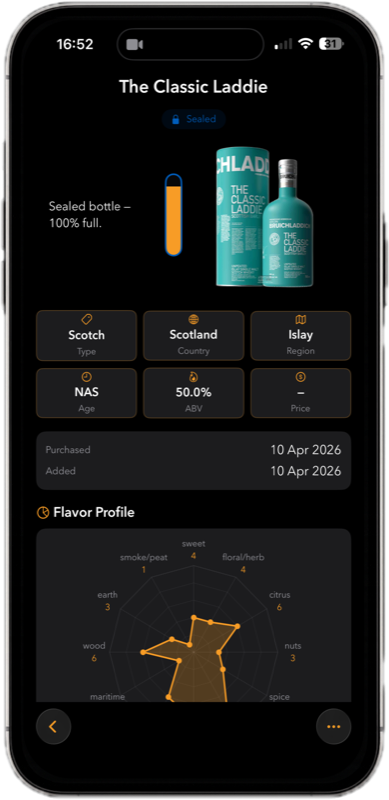
It was Bruichladdich. Octomore 11.2, to be precise. One of my favorite distilleries in the world. One of my favorite expressions in my collection. A whisky I hold in the highest regard. And I'd gotten it wrong.
That moment stayed with me -- not because I misidentified a whisky, but because of how quickly my mind wanted to interpret the experience. There was a subtle flicker of embarrassment. A quiet internal judgment. The sense that I 'should' have known better. After all, I've tasted widely. I speak often about distillery DNA. I've said -- sometimes with confidence, sometimes with a hint of hubris -- that certain distilleries announce themselves unmistakably in the glass. And yet here I was.
But as I sat with that moment longer, something shifted. The initial discomfort gave way to curiosity. Not "why did I get this wrong?" but "what does this reveal?" That question turned out to be far more interesting.
We live in a culture that treats accuracy as the highest virtue. From school onward, we're conditioned to equate being right with being competent, intelligent, or worthy. Tests reward correct answers. Mistakes are penalized. Over time, this logic seeps inward. We begin to evaluate ourselves the same way. But accuracy and understanding are not the same thing.
Accuracy is binary. It asks: is this correct or incorrect? It operates in snapshots. It is externally judged. Understanding, on the other hand, is cumulative. It unfolds across time. It depends on context, comparison, and revision. It is relational rather than absolute.
When I misidentified that whisky, my sensory perception wasn't wrong. The aroma was medicinal. The peat was assertive. The Islay character was present. What failed wasn't perception -- it was attribution. And attribution only stabilizes through comparison.
When I taste blind with multiple samples side by side, something subtle but powerful happens. The brain stops looking for certainty and starts looking for relationship. Differences sharpen. Similarities reveal themselves. Patterns begin to form -- not as fixed rules, but as tendencies.
But that night, tasting in isolation, the context collapsed. With only one data point, my brain latched onto the strongest available signal and extrapolated. That's not a personal flaw. That's how cognition works. Pattern recognition doesn't emerge from isolated accuracy. It emerges from structured contrast over time.
"I was wrong" is a statement that keeps the system open. It acknowledges a mismatch without assigning blame. It invites further inquiry. It strengthens context. It allows the mental model to adjust.
"I failed," on the other hand, closes the system. It frames the experience as a deficit of ability rather than a moment in a process. It discourages revisitation. It teaches avoidance instead of curiosity. Most of us were taught the second framing early and often. But learning doesn't thrive under judgment. It thrives under permission.
The value of that Octomore moment wasn't diminished by the misidentification. It was increased. I learned something about how phenolic notes overlap across distilleries. I learned something about how much my confidence relies on comparative context. I learned something about the limits of single-point tasting. Most importantly, I learned something about how understanding actually forms.
Experts are often described as people who "know." But in practice, expertise looks less like certainty and more like sensitivity. Experts notice nuance. They hold provisional conclusions lightly. They recognize when patterns are stable -- and when they're being misled. This kind of expertise cannot be built without repeated encounters with being wrong.
Each misstep adds dimensionality. Each revision strengthens the internal map. Over time, the brain doesn't just store answers; it stores relationships between answers. It becomes better at recognizing when it might be wrong, which is far more valuable than always being right.
The paradox is this: the people who appear most confident in complex domains are often those who are most comfortable being wrong privately.
One of the reasons being wrong feels so threatening is that we often carry our thinking entirely internally. When an idea or judgment fails, it feels like a personal failure rather than a hypothesis being tested. Externalizing thought changes that dynamic.
When you write something down -- whether it's a tasting note, a question, or a half-formed insight -- you create distance. The thought becomes an object you can return to, revise, or contradict. Earlier understandings don't need to be erased. They can coexist with later ones. This is how understanding deepens without self-reproach.
The act of recording "I thought this was X, but it turned out to be Y" is not an admission of incompetence. It's evidence of learning. It preserves the path, not just the destination.
Another quiet assumption we absorb early is that learning proceeds in straight lines: beginner to intermediate to advanced. But real learning is recursive. We circle back. We revisit ideas with new context. We reinterpret earlier experiences in light of later ones.
In whisky, this happens constantly. A dram tasted early in one's journey may feel simple or unremarkable. Years later, it reveals layers that were invisible before -- not because the whisky changed, but because the taster did. Being wrong is often the hinge point that enables that return.
When systems punish error, people optimize for safety rather than insight. They avoid difficult questions. They cling to familiar categories. They stop experimenting.
In whisky, this can show up as rigid preferences, "I don't like peat" or overconfident claims, "I can always spot this distillery." In learning more broadly, it shows up as shallow engagement and early plateauing. The cost isn't just personal. It's cultural. We lose depth when we lose patience with ambiguity.
What if we treated being wrong not as something to be corrected immediately, but as a signal worth examining? What if "wrong" simply meant "the model needs more context"?
In my case, the Octomore misidentification didn't tell me I lacked skill. It told me something about how certain aromas behave across expressions and how much comparative structure my perception relies on. That insight wouldn't have been available if I'd dismissed the moment as a failure and moved on.
There is a different kind of confidence that emerges when being wrong is no longer threatening. It's calmer. Less performative. More grounded. It doesn't rely on always being correct. It relies on trusting the process of understanding.
This confidence allows you to say, without defensiveness, "I don't know yet." Or, "I need to revisit this." Or, "I was wrong about that." And paradoxically, that openness makes deeper recognition possible.
Every time we revise an understanding, we add detail to the internal map. The map becomes richer not because it contains fewer errors, but because it contains more paths. Over time, those paths intersect. Patterns stabilize. Recognition becomes more reliable -- not because mistakes disappear, but because their lessons accumulate. In that sense, being wrong isn't a detour from learning. It is the terrain.
The whisky I misidentified that night didn't change. What changed was my relationship to the experience. Instead of shrinking, the moment expanded. That's the power of being wrong when it's allowed to remain a teacher rather than a verdict.
Accuracy has its place. But understanding -- real, durable understanding -- requires something braver: the willingness to be wrong, to record it, to return to it, and to let it quietly reshape how we see. Growth doesn't come from avoiding error. It comes from staying in relationship with it. And sometimes, the most meaningful insight in the glass isn't what it is -- but what it reveals about how we're learning to see.